Artur Sepp Blog on Quantitative Investment Strategies

  • Blog
  • Research
  • About
  • Category: Volatility Trading

    • Lognormal Stochastic Volatility – Youtube Seminar and Slides

      Posted at 6:14 am by artursepp, on October 25, 2024

      I would like to share the youtube video of my online seminar at Minnesota Center for Financial and Actuarial Mathematics and presentation slides.

      I discuss the motivation behind introducing Karasinki-Sepp log-normal stochastic volatility (SV) model in our IJATF paper with Parviz Rakhmonov. I briefly highlight the advantages of this model over existing SV models. Then I focus on new features of the model.

      For the first time, I formulate the dynamic of log-normal SV model consistent with the forward variance by construction. This formulation enables to automatically fit the model to a given term structure of variance swap strikes implied from market prices. I show that there is a small modification of the closed-form solution presented in our paper so that the existing solution can be applied here as well.

      Also for the first time, I introduce the rough formulation of the log-normal SV model. I note that our exponential affine expansion for the classic log-normal SV model can also be applied for the rough version, but it results in a system of multi-variate system of integral equations which is numerically tedious. We need to resort tom Monte-Carlo simulations of this model and Deep Learning for model calibration. This is work in progress so stay tuned.

      Finally, I present the model calibration to the time series of implied volatilities of options on Bitcoin traded on Deribit. I touch upon the calibration of mean-reversion parameters using empirical auto-correlation function discussed in our paper. The rest of model parameters: the current level and long-term mean volatility, volatility beta, and volatility-of-volatility are fitted in time series calibration.

      Below I show that the model error (the average difference between market and model implied volatility) is less than 1% most of the times. The volatility beta serves as the expected skeweness indicator switching from large negative values during risk-aversion and positive values during risk-seeking periods. This time series construction can serve as a base for relative value analysis and quant trading strategies.

      I mention that Python implementation of model is available in stochvolmodels package at Github. See an example of running the log-normal SV model and example of model calibration using the new formulation of term structure consistent with impled variance.


      Disclosure

      This research is a personal opinion and it does not represent an official view of my current and last employers.

      This paper and the post is an investment advice in any possible form.

      Share this:

      • Click to share on LinkedIn (Opens in new window) LinkedIn
      • Click to share on X (Opens in new window) X
      • Click to share on WhatsApp (Opens in new window) WhatsApp
      • Click to email a link to a friend (Opens in new window) Email
      • Click to print (Opens in new window) Print
      Posted in Crypto, Python, Volatility Modeling, Volatility Trading | 2 Comments
    • AD Derivatives podcast on volatility modeling and DeFi

      Posted at 7:28 pm by artursepp, on December 7, 2023

      I had a pleasure talking with Greg Magadini from Amberdata Derivatives. Greg is a seasoned options trader and he co-founded of GVol which provides awesome analytics for crypto options: check it out!

      We discussed many interesting topics including my background in becoming a quant, volatility modelling and trading, and my latest work in crypto options and DeFi.

      Greg put a nice summary to get you engaged

      https://blog.amberdata.io/ad-derivatives-podcast-feat-artur-sepp-head-quant-at-clearstar-labs

      and to watch the podcast on Youtube

      https://www.youtube.com/watch?v=3Km02FDIpxM

      Enjoy!

      Share this:

      • Click to share on LinkedIn (Opens in new window) LinkedIn
      • Click to share on X (Opens in new window) X
      • Click to share on WhatsApp (Opens in new window) WhatsApp
      • Click to email a link to a friend (Opens in new window) Email
      • Click to print (Opens in new window) Print
      Posted in Crypto, Uncategorized, Volatility Modeling, Volatility Trading | 0 Comments
    • Robust Log-normal Stochastic Volatility for Interest Rate Dynamics – research paper

      Posted at 5:49 pm by artursepp, on December 31, 2022

      The volatility of interest rates in 2022 has been indeed extreme. In Figure 1, I show the dependence the between the MOVE index (which measures the implied volatility of one-month options on UST bond futures and which is constructed similarly to the VIX index for implied volatilities of the S&P index futures), realized 10y UST rate volatility over the 6 months rolling window, and the level of 10y UST rates. For understanding of historical patterns, we classify the historical period from 2002 to the end of 2022 into the 5 periods: 2002-2007 (hiking cycle), 2008-2010 (tightening), 2011-2017 (QE), 2018-2020 (tightening), 2021-2022 (hiking cycle).

      We see that period of 2021-2022 was indeed unprecedented period when the rates rose from low levels of around 100 basis point (bp) to over 400bp, while the rates implied and realised volatilities rose from 50bps to over 150bps.

      Figure1. (A) The MOVE implied volatility index vs 10y UST bond rate; (B) 6m realized volatility of 10y UST bond rate vs 10y UST bond rate.

      The dependence between the rate and its volatility manifests in implied volatilities with positive skews as I show in Figure 2 (The market convention is to use Bachelier normal model for marking implied swaption volatilities).

      Figure 2. Implied normal volatilities for $10Y$ swaption as function of option expiries in basis points observed in December 2022. Option delta is Bachelier normal model delta.

      The dependence between the rate and volatility also manifests in strong level between the implied and realized volatilities and the volatility of volatility and the volatility beta (the change in 1bp of the volatility predicted by 1bp change in rates) which I show in Figure 3.

      Figure 3. (A) Realized volatility-of-volatility vs move volatility index. (B) Realized volatility beta vs Move index.

      Quantitative modeling of such dynamics is challenging. In my previous joint paper with Parviz Rakhmonov on the
      log-normal stochastic volatility for assets with positive return-volatility correlation we show that conventional SV model are ill-equipped for such dynamics. The rate dynamics are no exception, and practitioners rely on either local volatility models or local SV models with zero correlation. Both approaches are ill-poised because the may lead to explosive behavior of interest rates.

      In our extension with Parviz we apply the Karasinski-Sepp log-normal SV dynamic for modelling the interest rate volatility, which is available on SSRN: Robust Log-normal Stochastic Volatility for Interest Rate Dynamics

      We show that the proposed rates model is robust both on the quantitative dynamics and its practical implementation. While rate models in general are notorious for their tractability and implementation, we derive a closed form analytic solution for valuation of swaptions and for model calibration. In Figure 4, I show the model implied distribution of the 10y swap rate in the annuity measure computed using our analytical methods compared to the Monte Carlo simulations. Our solution is very accurate and it allows for robust calibration of the model to market data.

      Figure 4. Probability density functions computed using the first order affine expansion and the second-order expansion for the distribution of 10y swap rate in one year. The blue histogram is computed using realizations from MC simulations in model dynamics.

      All the technical details are available in the paper: Robust Log-normal Stochastic Volatility for Interest Rate Dynamics. Happy reading.

      Share this:

      • Click to share on LinkedIn (Opens in new window) LinkedIn
      • Click to share on X (Opens in new window) X
      • Click to share on WhatsApp (Opens in new window) WhatsApp
      • Click to email a link to a friend (Opens in new window) Email
      • Click to print (Opens in new window) Print
      Posted in Quantitative Strategies, Volatility Modeling, Volatility Trading | 1 Comment
    • Log-normal Stochastic Volatility Model for Assets with Positive Return-Volatility Correlation – research paper

      Posted at 3:04 pm by artursepp, on August 10, 2022

      I am introducing my most recent research on log-normal stochastic volatility model with applications to assets with positive implied volatility skews, such as VIX index, short index ETFs, cryptocurrencies, and some commodities.

      Together with Parviz Rakhmonov, we have extended my early work on Karasinski-Sepp log-normal volatility model and we have written an extensive paper with an extra focus on modelling implied volatilities of assets with positive return-volatility correlation in addition to deriving a closed-form solution for option valuation under this model.

      Assets with positive implied volatility skews and return-volatility correlations

      While it is typical to observe negative correlation between returns of an asset and changes in its implied and realized volatilities, there are in fact many assets with positive return-volatility correlation and, as a consequence, with positive implied volatility skews. In below Figure, I show some representative examples.

      (A) The VIX index provides protection against corrections in the S&P 500 index, so that out-of-the-money calls on VIX futures are valuable and demand extra risk-premia than puts.

      (B) Short and leveraged short ETFs on equity indices have positive implied volatility skews because of their anti-correlation with underlying equity indices. I use 3x Short Nasdaq ETF with NYSE ticker SQQQ, which is the largest short ETF in US equity market and which has very liquid listed options market.

      (C) Cryptocurrencies, including Bitcoin and Ethereum, and “meme” stocks, such as AMC, have positive skews during speculative phases when positive returns feed speculative demand for upside. These self-feeding price dynamics increase the demand for calls following a period of rising prices. However, positive return-volatility correlation tend to reverse once “greed” regime is over and “risk-off” regime prevails.

      (D) Gold and commodities in general may have positive volatility skews dependent on supply-demand imbalances, seasonality, etc.

      Importantly, the valuation of options on these assets is not feasible using conventional stochastic volatility models applied in practice such as Heston, SABR, Exponential Ornstein-Uhlenbeck stochastic volatility models, because these models fail to be arbitrage-free (forwards and call prices are not martingals). Curiously enough, the topic of no-arbitrage for SV models with positive return-volatility correlation has not received attention in literature, despite a large number of assets with positive return-volatility correlation.

      Applications to Options on Cryptocurrencies

      Additional, yet important application of our work is the pricing of options on cryptocurrencies, where call and put options with inverse pay-offs are dominant. The advantage of inverse pay-offs for cryptocurrency markets is that all option-related transactions can be handled using units of underlying cryptocurrencies, such as Bitcoin or Ethereum, without using fiat currencies. Critically, since both inverse options (traded on Deribit exchange) and vanilla (traded on CBOE) are traded for cryptocurrencies, a stochastic volatility must satisfy the martingale condition for both money-market-account and inverse measures to exclude arbitrage opportunities between vanilla and inverse options. We show that prices dynamics in our model are martingales under the both inverse and money-market-account measures.

      In below Figure, I show the model fit to Bitcoin options observed on 21-Oct-2021 (the period with positive skew) for most liquid maturities of 2 weeks, 1 month, and 2 and 3 months. We see that the model calibrated to Bitcoin options data is able to capture the market implied skew very well across most liquid maturities with only 5 model parameters. The average mean squared error (MSE) is about 1% in implied volatilities, which is mostly within the quoted bid-ask spread. Calibration to ATM region can be further improved using a term structure of the mean volatility or augmenting the SV model with a local volatility part to fit accurately to the implied volatility surface.

      Model applications

      The quality of model fit is similar for other assets with either positive or negative skews. The main strength of our model is that it can be used for the following purposes.

      1. Cross-sectional no-arbitrage model for different exchanges and options referencing the same underlying.
      2. Model for time series analysis of implied volatility surfaces.
      3. Dynamic valuation model for structured products and option books.

      Further resources

      SSRN paper Log-normal Stochastic Volatility Model with Quadratic Drift https://ssrn.com/abstract=2522425

      Github project with the example of model implementation in Python: https://github.com/ArturSepp/StochVolModels

      Youtube video with lecture I made at Imperial College for model applications for Bitcoin volatility surfaces: https://youtu.be/dv1w_H7NWfQ

      Youtube podcast with introduction of the paper and review of Github project with Python analytics for model implementation: https://youtu.be/YHgw0zyzT14

      Disclaimer

      The views and opinions presented in this article and post are mine alone. This research is not an investment advice.

      Share this:

      • Click to share on LinkedIn (Opens in new window) LinkedIn
      • Click to share on X (Opens in new window) X
      • Click to share on WhatsApp (Opens in new window) WhatsApp
      • Click to email a link to a friend (Opens in new window) Email
      • Click to print (Opens in new window) Print

      Like this:

      Like Loading...
      Posted in Crypto, Python, Volatility Modeling, Volatility Trading | 1 Comment
    • My talk on Machine Learning in Finance: why Alternative Risk Premia (ARP) products failed

      Posted at 2:56 pm by artursepp, on November 27, 2018

      I have recently attended and presented at Swissquote Conference on Machine Learning in Finance. With over 250 participants, the event was a great success to hear from the industry leaders and to see the recent developments in the field.

      The conference featured very interesting talks ranging from an application of natural language processing (NLP) for industry classifications to a systematic trading in structured products using deep learning. For the interested, the slides and videos are available on the conference page.

      I would like to share and introduce my talk presented at the conference on applications of machine learning for quantitative strategies (the video of my talk available here).

      In my talk, I address the limitations of applying machine learning (ML) methods for quantitative trading given limited sample sizes of financial data. I illustrate the concept of probably approximately correct (PAC) learning that serves as a foundation to the complexity analysis of machine learning.

      In particular, the PAC learning establishes model-free bounds on the sample size to estimate a parametric function from the sample data for a specified level of approximation and estimation error. I recommend very nice textbooks An Elementary Introduction to Statistical Learning Theory and The Nature Of Statistical Learning Theory to study more about the PAC learning.

      I also present an example of using supervised learning for the selection of volatility models for systematic trading from my earlier presentation.

      Finally, I touch on the important topic of the risk-profile of quantitative investment strategies and, in particular, Alternative Risk Premia (ARP) products. For the past few years, since about 2015, the sell-side have been marketing a plethora of ARP products as “cheap” substitutes for hedge fund strategies. However, ARP products fared miserably throughout year 2018 despite the fact that most of these products were marketed as market-neutral. I wanted to share my view why ARP products failed…

      The typical creation process of ARP products is as follows. First, a research team runs multiple back-tests of “academic” risk factors (value, carry, momentum, etc) across many markets until a specific parametrization of their strategy produces a satisfactory Sharpe ratio (around 1.0 or so). Once the necessary performance target is achieved in the back-test, the research team along with a marketing team would write a research paper with economic justification of the strategy. Then the marketing team would pitch the strategy to institutional clients. If the marketing team is successful, they would raise money for the strategy. Finally, the successful strategy (out of dozens of attempted) would reach to the execution team who would implement the strategy in a trading system and execute on behalf of clients.

      The creation of ARP products serve as a prime example why we need to understand the limitations of statistical learning given limited sample sizes of financial data. Also, there is the incentive to fit a rich model to the limited sample to optimize the in-sample performance. For an example, using PAC learning, to estimate a model with 10 parameters at an approximation error within 10% we need to apply 2,500 daily observations!

      It is no coincidence that ARP product suffered a major blow once market conditions changed. As we speak, post October 2018, quants are facing a crisis of confidence.

      In the hindsight, year 2018 brought to the failure the two very popular strategies:

      1) The short volatility ETNs: the figure at the top of the post illustrates how would a naive 5-parameter regression fit the in-sample data of past two years with the accuracy of 98%, but the fitted model fails miserably in February 2018 (I posted a detailed statistical analysis of the crash).

      2) The alternative risk-premia products: the figure below shows the risk-profile of Bank Systematic Risk Premia Multi-Asset Index compiled by the Hedge Fund Research.

      In the figure below, as the predictor, I use the quarterly returns on the S&P 500 index which I condition into the three regimes: bear (16% of the sample), normal (68%), and bull (16%). Then I consider the quarterly returns on the HFR index conditional on these regimes and illustrate the corresponding regression of returns on the HFR index predicted by returns on the S&P 500 index.

      It is clear that the HFR index sells 3 puts to buy 5 calls to obtain the leveraged exposure to the S&P 500 index. Well, over the past decade these models learned to leverage the upside at the cost of selling the downside.

      BankRiskPremia.png

      The key message from my talk is that, we may be able to avoid the traps of applying machine and statistical learning methods for systematic trading strategies by understanding the theoretical grounds of the ML methods and the potential limitations of using only limited sample sizes for the estimation of these models.


      Disclaimer

      All statements in this presentation are the author personal views. The information and opinions contained herein have been compiled or arrived at in good faith based upon information obtained from sources believed to be reliable. However, such information has not been independently verified and no guarantee, representation or warranty, express or implied, is made as to its accuracy, completeness or correctness. Investments in Alternative Investment Strategies are suitable only for sophisticated investors who fully understand and are willing to assume the risks involved. Alternative Investments by their nature involve a substantial degree of risk and performance may be volatile.


      Share this:

      • Click to share on LinkedIn (Opens in new window) LinkedIn
      • Click to share on X (Opens in new window) X
      • Click to share on WhatsApp (Opens in new window) WhatsApp
      • Click to email a link to a friend (Opens in new window) Email
      • Click to print (Opens in new window) Print
      Posted in Quantitative Strategies, Uncategorized, Volatility Modeling, Volatility Trading | 2 Comments
    • Machine Learning for Volatility Trading

      Posted at 6:33 am by artursepp, on May 29, 2018

      Recently I have been working on applying machine learning for volatility forecasting and trading. I presented some of my findings at QuantMinds Conference 2018 which I wanted to share in this post.

      My presentation is available at SSRN with the video of the talk in YouTube.

      Continue reading →

      Share this:

      • Click to share on LinkedIn (Opens in new window) LinkedIn
      • Click to share on X (Opens in new window) X
      • Click to share on WhatsApp (Opens in new window) WhatsApp
      • Click to email a link to a friend (Opens in new window) Email
      • Click to print (Opens in new window) Print
      Posted in Asset Allocation, Quantitative Strategies, Uncategorized, Volatility Modeling, Volatility Trading | 3 Comments
    • Lessons from the crash of short volatility ETPs

      Posted at 6:50 am by artursepp, on February 15, 2018

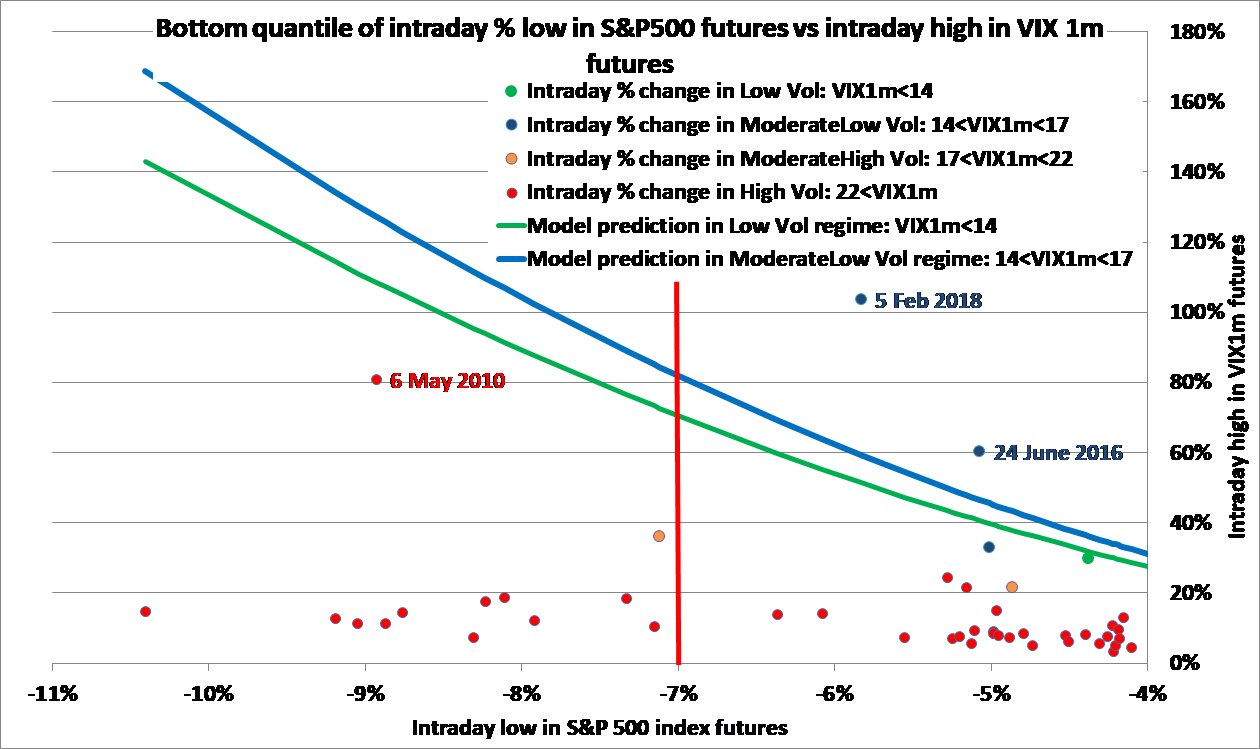
      Exchange traded products with the short exposure to the implied volatility of the S&P 500 index have been proliferating prior to “Volatility Black Monday” on the 5th of February 2018. To investigate the crash of short volatility products, I will analyse the intraday risk of these products to steep intraday declines in the S&P 500 index. As a result, I will demonstrate that these products have been poorly designed from the beginning having too strong sensitivity to a margin call on a short notice. In fact, I estimate that the empirical probability of such a margin call has been high. To understand the performance of product with the short exposure to the VIX, I will make an interesting connection between the short volatility strategy and leveraged strategies in the S&P 500 index and investment grade bonds. Finally, I will discuss some ways to reduce the drawdown risk of short volatility products.

      Key takeaways

      • Exchange traded products (ETPs) for investing in volatility may not be appropriate for retail investors because, to deliver the lasting performance in the long-term, these products need risk controls and dynamic rebalancing to avoid steep drawdowns and to optimise the carry costs from the VIX futures curve.
      • The convexity of VIX changes and the sensitivity of changes in the VIX futures to changes in the S&P 500 index is extremely high in regimes with low and moderate levels of the implied volatility. As a result, a margin call on short volatility ETPs is more likely to occur in periods with low to medium volatility rather than in periods with high volatility.
      • Without proper risk-control on the notional exposure, ETPs with the short VIX exposure are too sensitive to the intraday margin calls on a very short notice. Empirically, in the regimes with medium volatility, an intraday decline of 7% in the S&P 500 index is expected lead to 80-100% spike in the VIX futures and, as a result, to margin calls for short volatility ETPs.
      • Short volatility ETNs provide with a leveraged beta exposure to the performance of the S&P 500 index, there is no alpha in these strategies. This leveraged exposure can be replicated using either S&P 500 index with leverage of 4.2 to 1 or with investment grade bonds with leverage of 9.6 to 1. All these strategies perform similarly well in a bull market accompanied by a small realized volatility and significant roll yields, yet these leveraged strategies are subject to a margin call on daily basis.

      Continue reading →

      Share this:

      • Click to share on LinkedIn (Opens in new window) LinkedIn
      • Click to share on X (Opens in new window) X
      • Click to share on WhatsApp (Opens in new window) WhatsApp
      • Click to email a link to a friend (Opens in new window) Email
      • Click to print (Opens in new window) Print
      Posted in Quantitative Strategies, Uncategorized, Volatility Modeling, Volatility Trading | 7 Comments
    • Diversifying Cyclicality Risk of Quantitative Investment Strategies: presentation slides and webinar Q&A

      Posted at 5:21 pm by artursepp, on December 1, 2017

      What is the most significant contributing factor to the performance of a quantitative fund: its signal generators or its risk allocators? Can we still succeed if we have good signal generators but poor risk management? How should we allocate to a portfolio of quantitative strategies?

      I have developed a top-down and bottom-up model for portfolio allocation and risk-management of quantitative strategies. The interested readers can find  the slides of my presentation here  and can watch the webinar can be viewed on youtube.

      Keep on Reading!

      Share this:

      • Click to share on LinkedIn (Opens in new window) LinkedIn
      • Click to share on X (Opens in new window) X
      • Click to share on WhatsApp (Opens in new window) WhatsApp
      • Click to email a link to a friend (Opens in new window) Email
      • Click to print (Opens in new window) Print
      Posted in Asset Allocation, Quantitative Strategies, Trend-following, Uncategorized, Volatility Modeling, Volatility Trading | 1 Comment
    • Volatility Modelling and Trading: Workshop presentation

      Posted at 5:13 pm by artursepp, on November 1, 2017

      During past years I have found the great value in using implied and realized volatilities for volatility trading and quantitative investment strategies. The ability to stay focused and to follow quantitative models for investment decisions is what sets you apart in these volatile markets and contributes to your performance. The implied volatility from option prices typically overestimates the magnitude of extreme events across all assets – see the figure above The volatility risk-premia can indeed be earned using a quantitative model.

      Nevertheless, after many years of working on volatility models, I realize that there a lot of gaps and inconsistencies in existing models for measuring and trading volatility. Unsurprisingly, by designing a model that sets you apart from the existing ones, you can significantly improve the performance of your investment strategies.

      In workshop presentation at Global Derivatives Conference 2016  I have discussed in depth the volatility risk premia. The beginning and largest part of the presentation is devoted to measuring and estimating historical volatilities. The historical volatility is the key to many of the quantitative strategies, so that the historical volatility an important starting point in all applications. Then I discuss delta-hedging, transaction costs, and macro-risk management. Finally, I discuss using volatility for systematic investment strategies.


      Share this:

      • Click to share on LinkedIn (Opens in new window) LinkedIn
      • Click to share on X (Opens in new window) X
      • Click to share on WhatsApp (Opens in new window) WhatsApp
      • Click to email a link to a friend (Opens in new window) Email
      • Click to print (Opens in new window) Print
      Posted in Quantitative Strategies, Uncategorized, Volatility Modeling, Volatility Trading | 0 Comments
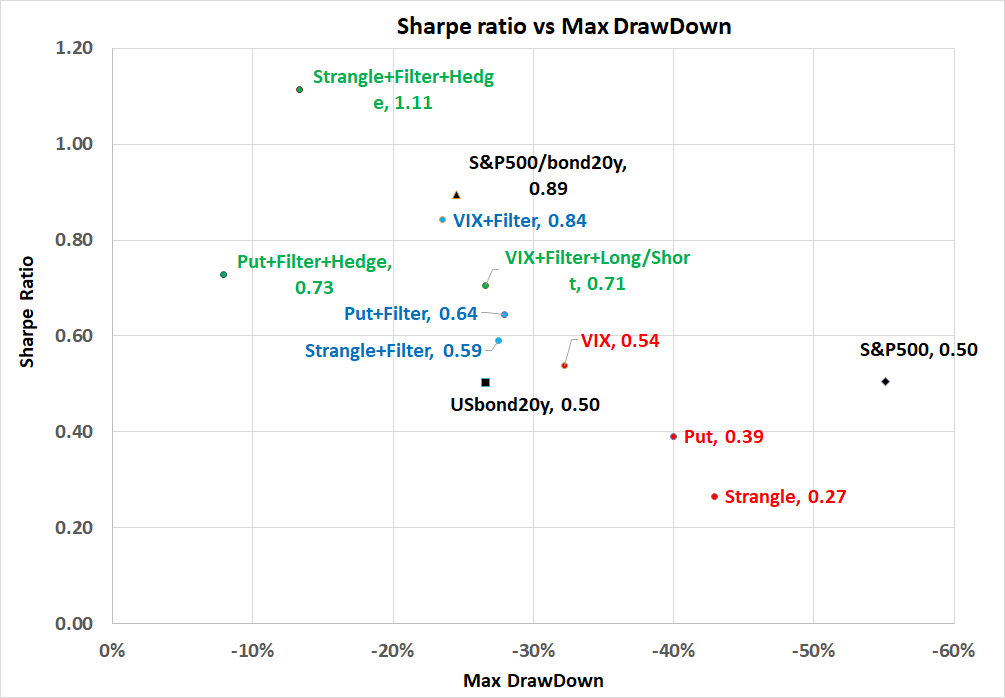
    • Allocation to systematic volatility strategies using VIX futures, S&P 500 index puts, and delta-hedged long-short strategies

      Posted at 3:45 pm by artursepp, on September 20, 2017

      I present a few systematic strategies for investing into volatility risk-premia and illustrate their back-tested performance. I apply the four factor Fama-French-Carhart model to attribute monthly returns on volatility strategies to returns on the style factors. I show that all strategies have insignificant exposure to the style factors, while the exposure to the market factor becomes insignificant when strategies are equipped with statistical filtering and delta-hedging. I show that, by allocating 10% of portfolio funds to these strategies within equity and fixed-income benchmarked portfolios, investors can boost the alpha by 1% and increase the Sharpe ratio by 10%-20%.

      Keep on Reading!

      Share this:

      • Click to share on LinkedIn (Opens in new window) LinkedIn
      • Click to share on X (Opens in new window) X
      • Click to share on WhatsApp (Opens in new window) WhatsApp
      • Click to email a link to a friend (Opens in new window) Email
      • Click to print (Opens in new window) Print
      Posted in Asset Allocation, Quantitative Strategies, Uncategorized, Volatility Modeling, Volatility Trading | 4 Comments
    ← Older posts
    • Receive notifications of new posts by email

      Join 339 other subscribers
    • Recent Posts

      • The Science and Practice of Trend-following Systems: paper and presentation
      • Lognormal Stochastic Volatility – Youtube Seminar and Slides
      • Optimal allocation to cryptocurrencies in diversified portfolios – update on research paper
      • Unified Approach for Hedging Impermanent Loss of Liquidity Provision – Research paper
      • Log-normal stochastic volatility with quadratic drift – open access publication
      • Stochastic Volatility for Factor Heath-Jarrow-Morton Framework – research paper
      • AD Derivatives podcast on volatility modeling and DeFi
      • What is a robust stochastic volatility model – research paper
      • Robust Log-normal Stochastic Volatility for Interest Rate Dynamics – research paper
      • Optimal Allocation to Cryptocurrencies in Diversified Portfolios – research paper
      • Log-normal Stochastic Volatility Model for Assets with Positive Return-Volatility Correlation – research paper
      • Developing systematic smart beta strategies for crypto assets – QuantMinds Presentation
      • Toward an efficient hybrid method for pricing barrier options on assets with stochastic volatility – research paper
      • Paper on Automated Market Making for DeFi: arbitrage-fee exchange between on-chain and traditional markets
      • Tail risk of systematic investment strategies and risk-premia alpha
      • Trend-Following CTAs vs Alternative Risk-Premia (ARP) products: crisis beta vs risk-premia alpha
      • My talk on Machine Learning in Finance: why Alternative Risk Premia (ARP) products failed
      • Why Python for quantitative trading?
      • Machine Learning for Volatility Trading
      • Trend-following strategies for tail-risk hedging and alpha generation
    • Categories

      • Asset Allocation (10)
      • Crypto (8)
      • Decentralized Finance (5)
      • Python (4)
      • Quantitative Strategies (17)
      • Trend-following (4)
      • Uncategorized (20)
      • Volatility Modeling (18)
      • Volatility Trading (13)


Loading Comments...
 

    %d