Artur Sepp Blog on Quantitative Investment Strategies

  • Blog
  • Research
  • About
  • Category: Trend-following

    • The Science and Practice of Trend-following Systems: paper and presentation

      Posted at 5:35 pm by artursepp, on June 22, 2025

      I would like to introduce the updated draft of my paper co-authored with Vladimir Lucic and entitled “The Science and Practice of Trend-following Systems”.

      Trend-following systems have been employed by many quantitative and discretionary funds, also known as commodity trading advisors (CTAs), or managed futures, since the early 1980s. Richard Dennis, a commodity trader on the CME, organised and instructed two classes of novice traders in late 1983 and 1984 with the idea that trading skills can be taught. The underlying ideas and methods included strict adherence to rule-based trading and risk-management. A few graduates of these classes created their own quantitatively-driven CTA funds and gave the rise of managed futures industry.

      Lintner in 1983 provided the first evidence that managed futures deliver better risk-adjusted returns and offer strong diversification benefits for long-only portfolios. The following passage is from Lintner 1983, The Potential Role of Managed Commodity-Financial Futures Accounts (and/or Funds) in Portfolios of Stocks and Bonds:
      “The combined portfolios of stocks (or stocks and bonds) after including judicious investments in appropriately selected sub-portfolios of investments in managed futures accounts (or funds) show substantially less risk at every possible level of expected return than portfolios of stock (or stocks and bonds) alone. This is the essence of the ‘potential role’ of managed futures accounts (or funds) as a supplement to stock and bond portfolios suggested in the title of this paper.”

      Subsequent studies reinforce the role of managed futures for the diversification of broad long-only portfolios, so that currently many private and institutional portfolios have some exposure to managed futures.

      The purpose of this paper is to provide both theoretical and practical insights about trend-following (TF) systems. Let me note that practitioners refer to implemented systematic futures-based strategies as systems or programs.

      Theoretical insights

      For theoretical insights, we establish regimes in which TF systems perform well. For any systematic strategy, it is important to understand under which market dynamics it is expected to out-perform or under-perform.  We derive an exact analytical formula linking the performance of the TF system to the autocorrelation of instrument returns under generic processes. We show that the TF system is expected to be profitable when the autocorrelation of returns is positive even if the drift is zero. We also show that the TF system is expected to be profitable for a white noise process with a large positive or negative drift if the filter span is large.

      For the illustration of obtained analytical results, we focus on fractional ARFIMA process which incorporates both short- and long-term mean reversion and / or trend features, which allows for extensive profitability analysis of TF systems.

      In Figure 1, we illustrate that the TF system can be profitable if the fractional order is positive, so the dynamics are trending in the long-term. In this case, the TF system can be profitable even if the short-term dynamics are mean-reverting.

      Figure 1. Panel (A) shows analytical value of expected annual return of TF system and MC confidence intervals using ARFIMA process with positive long-term memory with fractional order $d=0.02$, which implies long-term mean-reversion, with AR-1 feature phi={-0.05, 0.0, 0.05, and with zero drift. Panel (B) shows expected value of volatility-adjusted turnover and corresponding MC 95% confidence interval.

      In Figure 2, we illustrate that if the fractional order is negative and dynamics are mean-reverting in the long-term, the TF system can still be profitable if drift is present and span of the filter is large.

      Figure 2. Panel (A) shows analytical value of expected annual return of TF system and MC confidence intervals for ARFIMA process with negative long-term memory with fractional order d=-0.01. with AR-1 feature phi={-0.05, 0.0, 0.05} and with drift mu=0.5 (interpreted as Sharpe ratio) . Panel (B) shows expected value of volatility-adjusted turnover and corresponding MC 95% confidence interval.

      Practical Insights

      We have considered three distinct approaches for the construction of trend-following (TF) approaches which we term as European, American, and Time Series Momentum (TSMOM) systems. In Figure 3, we show the simulated performance of three TF systems assuming 2%/20% management/performance fees.

      Figure 3. Simulated performance of of European, American and TSMOM systems along with the historical performance of SG Trend Index. Panels (A1), (B1), and (C1) show the cumulative log-performance, running drawdown, and EWMA correlations with one year span. Panel (A2i) shows risk-adjusted performance table with P.a. returns being annualised return or CAGR, Vol being annualised volatility of daily log returns, Sharpe (rf=0) being Sharpe ratio, Max DD being the maximum drawdown; Skew being the skewness of quarterly log-returns, beta and R^{2} being the the slope and R^{2} of the linear regression of monthly returns relative to 60/40 equity/bond portfolio. Panel (A2ii) shows annual returns. Panels (B2) and (B3) show one year rolling volatility-adjusted turnover and cost, respectively. The background colour is obtained by ordering the quarterly returns of the benchmark 60/40 portfolio from lowest to highest and the splitting the 16% of worst returns into the “bear” regime (pink colour), 16% of best returns into the bull regime (dark green colour), and remaining regimes into “normal” regimes (light green colour). The period of performance measurement is from 31 December 1999 to 1 June 2025.

      This illustration emphasises the robustness of TF systems, as different quantitative models can provide first-order exposure to trending features of financial markets. Most CTA managers pursue to deliver outperformance over the benchmark index by second-order proprietary features including exposures to style factors (carry, value, cross-sectional momentum, etc.), risk-management (portfolio volatility targeting, asset class exposure management, etc.), operational capabilities (exposure to smaller or alternative futures markets, enhanced execution, etc.), and other risk premia (e.g. volatility carry) — see Carver 2023, Advanced Futures Trading Strategies, for a detailed overview of additional features and strategies commonly combined with managed futures.

      Smart Diversification of Long-only Portfolios

      We also analyse the diversification benefits of how blending of TF systems long-only portfolios with long-only portfolios. In Figure 4, we generate blended portfolios with (1-x)% weight to 60/40 Equity/Bond portfolio and with x% weight to each of the three TF systems with x varying from 0% to $100%. Blended portfolios are rebalanced quarterly and, for TF systems, we use their net performance. The initial portfolio on the left is 100%/0% blend of 60/40 portfolio and 0% TF system. The final portfolio on the right is 0%/100% blend. Hereby, we measure portfolio risk by the Bear-Sharpe ratio (the performance in 16% worst quarters of 60/40 equity / bond portfolio) and portfolio performance by total Sharpe ratio.

      Figure 4. Bear-Sharpe ratio vs total Sharpe ratio for blended portfolios with (1-x)% weight to 60/40 portfolio and x% weight to each of the three TF systems. The initial portfolio on the left is 100%/0%$ blend of 60/40 portfolio and 0% TF system. The final portfolio on the right is 0%/100% blend. The specification of TF systems is the same as for generation of Figure 3.

      We observe that the best combination of European and American TF systems that generates the highest Sharpe ratio is the 40%/60% combination of the 60/40 portfolio / TF system. In this case, the realised Bear-Sharpe ratio is close to zero, while the total Sharpe ratio is about 0.9, which is almost double the Sharpe ratios of its components. As we see in Figure 3, the TSMOM system has a Bear-Sharpe ratio attribution of 50% smaller than that of European and American TFs. Thus, the Bear-Sharpe ratio emphasises the diversification efficiency for long-only portfolios.

      We note that, because implementation of a TF system requires only a limited capital for margin requirements of trading futures, a TF system can implemented as an overlay to 100% exposure to a long-only portfolio. If we take the 50%/50% blend (which is not far from the optimal blend 40%/60% in Figure 4 and leverage it twice, we obtain the portfolio with 100% exposure to the 60/40 portfolio and 100% exposure to a TF system. We note that recent advances in portfolio products termed “stacking alphas” or “portable alphas”  (see Gordillo-Hoffstein, 2024, Return Stacking: Strategies For Overcoming A Low Return Environment) are based on the same concept of blending a fixed 100% exposure to a long-only portfolio and 100% (or similar) exposure to a TF system or a general managed futures program.

      Further Applications

      Our results, allow for prediction of the performance of TF systems conditional on certain dynamics, such as ARFIMA process. This could be applied for instrument selection and signal/weights adjustments.

      Given that we also derive a very good approximate formulas for the expected turnover of European TF system, our results can be applied for quick optimisations of TF systems.

      Finally, our “Smart Diversification” based on regime-conditional Sharpe ratios enables for design of overlays using TF systems for long-only portfolios. In particular, we show that the optimal weight, according to our “Smart Diversification”, of TF system for 60/40 portfolio is 50%. Return stacked portfolios are obtained by 2x leverage of 50%/50% blend of 60/40 portfolio / TF system.

      Links

      Our paper is available on SSRN: https://papers.ssrn.com/sol3/papers.cfm?abstract_id=3167787

      I presented our paper at CQF Volatility and Risk conference with slides available here and Youtube video of my presentation is available here

      Disclosure

      This research is a personal opinion and it does not represent an official view of my current and last employers.

      This paper and the post is an investment advice in any possible form.
      Share this:

      • Click to share on LinkedIn (Opens in new window) LinkedIn
      • Click to share on X (Opens in new window) X
      • Click to share on WhatsApp (Opens in new window) WhatsApp
      • Click to email a link to a friend (Opens in new window) Email
      • Click to print (Opens in new window) Print
      Posted in Asset Allocation, Quantitative Strategies, Trend-following, Uncategorized | 1 Comment
    • Tail risk of systematic investment strategies and risk-premia alpha

      Posted at 2:55 pm by artursepp, on April 9, 2019

      Everyone knows that the risk profile of systematic strategies can change considerably when equity markets turn down and volatilities spike. For an example, a smooth profile of a short volatility delta-hedged strategy in normal regimes becomes highly volatile and correlated to equity markets in stressed regimes.

      Is there a way to systematically measure the tail risk of investment products including hedge funds and alternative risk premia strategies? Further, how do we measure the risk-premia compensation after attribution for tail risks? Finally, would we discover patterns in cross-sectional analysis of different hedge fund strategies?

      I have been working through years on a quantitative framework to analyse the above raised questions and recently I wrote two articles on the topic:

      1. The regime-conditional regression model is introduced in The Hedge Fund Journal (online paper).
      2. A short review of the methodology and results is presented for QuantMinds

      I would like to highlight the key results of the methodology so that interested readers can further follow-up with the original sources.

      Regime conditional index betas

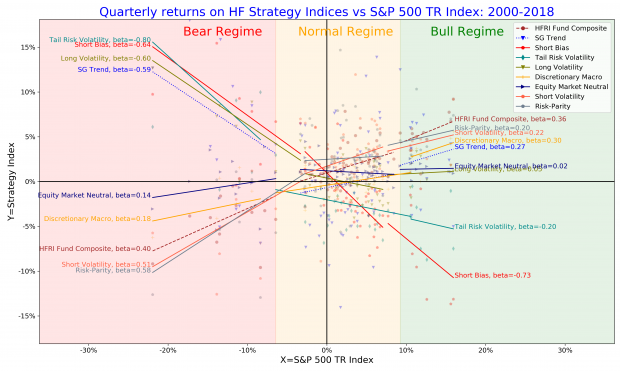
      In the top Figure, I show the regime conditional betas for a selection of hedge fund style from HFR indices data using the S&P 500 index as the equity benchmark.

      We can classify the strategies into defensive and risk-seeking based on their return profile in bear market regimes:

      1. Defensive strategies (long volatility, short bias, trend-following CTAs) have negative equity betas in bear regime so that these strategies serve as diversifiers of the equity downside risk.
      2. Risk-seeking strategies (short volatility, risk-parity) have positive and significant equity betas in bear regime. Equity betas of most of risk-seeking strategies are relatively small in normal and bull periods but equity betas increase significantly in bear regimes. I term these strategies as Risk-seeking risk-premia strategies.
      3. I term strategies with insignificant betas in normal bear regimes as Diversifying strategies. Examples include equity market neutral and discretionary macro strategies because, even though these strategies have positive betas to the downside, the beta profile does not change significantly between normal and bear regimes. As a result, the marginal increase in beta exposure between normal and bear periods is insignificant.

      Risk-premia alpha vs marginal bear beta

      I define the risk-premia alpha as the intercept of the regime-conditional regression model for strategy returns regressed by returns on the benchmark index. To show a strong relationship between the risk-premia alpha and marginal bear beta (the marginal bear betas are computed as the difference between betas in normal and bear regimes), I apply the cross-sectional analysis of risk premia for the following sample of hedge fund indices and alternative risk premia (ARP) products, using quarterly returns from 2000 to 2018 against the S&P 500 total return index:

      1. HF: Hedge fund indices from major index providers including HFR, SG, BarclayHedge, Eurekahedge with the total of 73 composite hedge fund indices excluding CTA indices;
      2. CTA: 7 CTA indices from the above providers and 15 CTA funds specialized on the trend-following;
      3. Vol: 28 CBOE benchmark indices for option and volatility based strategies;
      4. ARP: ARP indices using HFR Bank Systematic Risk-premia Indices with a total of 38 indices.

      In figure below, I plot risk-premia alphas against marginal bear betas grouped by strategy styles. For defensive strategies, their marginal bear betas are negative; for risk-seeking strategies, the marginal bear betas are positive and statistically significant.

      cross_sectional_rp 20190405-085150

      We see the following interesting conclusions.

      1. For volatility strategies, the cross-sectional regression has the strongest explanatory power of 90%. Because a rational investor should require a higher compensation to take the equity tail risk, we observe such a clear linear relationship between the marginal tail risk and the risk-premia alpha. Defensive volatility strategies that buy downside protection have negative marginal betas at the expense of negative risk-premia alpha.
      2. For alternative risk premia products, the dispersion is higher (most of these indices originate from 2007), yet we still observe the pattern between the defensive short and risk-seeking risk-premia strategies with negative and positive risk-premia alpha, respectively.
      3. For hedge fund indices, the dispersion of their marginal bear beta is smaller. As a result, most hedge funds serve as diversifiers of the equity risk in normal and bear periods; typical hedge fund strategies are not designed to diversify the equity tail risk.
      4. All CTA funds and indices have negative bear betas with insignificant risk-premia alpha. Even though their risk-premia alpha is negative and somewhat proportional to marginal bear beta is proportional, the risk-premia alpha is not statistically significant. In this sense, CTAs represent defensive active strategies. The contributors to slightly negative risk-premia alpha may include transaction costs and management fees.


      References

      Sepp A., Dezeraud L., (2019), “Trend-Following CTAs vs Alternative Risk-Premia: Crisis beta vs risk-premia alpha”, The Hedge Fund Journal, Issue 138, page 20-31, https://thehedgefundjournal.com/trend-following-ctas-vs-alternative-risk-premia/

      Sepp, A. The convexity profile of systematic strategies and diversification benefits of trend-following strategies, QuantMinds, April 2019

      Share this:

      • Click to share on LinkedIn (Opens in new window) LinkedIn
      • Click to share on X (Opens in new window) X
      • Click to share on WhatsApp (Opens in new window) WhatsApp
      • Click to email a link to a friend (Opens in new window) Email
      • Click to print (Opens in new window) Print
      Posted in Asset Allocation, Quantitative Strategies, Trend-following, Uncategorized, Volatility Modeling | 1 Comment
    • Trend-following strategies for tail-risk hedging and alpha generation

      Posted at 11:39 am by artursepp, on April 24, 2018

      Because of the adaptive nature of position sizing, trend-following strategies can generate the positive skewness of their returns, when infrequent large gains compensate overall for frequent small losses. Further, trend-followers can produce the positive convexity of their returns with respect to stock market indices, when large gains are realized during either very bearish or very bullish markets. The positive convexity along with the overall positive performance make trend-following strategies viable diversifiers and alpha generators for both long-only portfolios and alternatives investments.

      I provide a practical analysis of how the skewness and convexity profiles of trend-followers depend on the trend smoothing parameter differentiating between slow-paced and fast-paced trend-followers. I show how the returns measurement frequency affects the realized convexity of the trend-followers. Finally, I discuss an interesting connection between trend-following and stock momentum strategies and illustrate the benefits of allocation to trend-followers within alternatives portfolio.

      Interested readers can download the pdf of my paper on SSRN

      Key takeaway

      1. Risk-profile of quant strategies

      The skewness and the convexity of strategy returns with respect to the benchmark are the key metrics to assess the risk-profile of quant strategies. Strategies with the significant positive skewness and convexity are expected to generate large gains during market stress periods and, as a result, convex strategies can serve as robust diversifiers. Using benchmark Eurekahedge indices on major hedge fund strategies, I show the following.

        • While long volatility hedge funds produce the positive skewness, they do not produce the positive convexity.
        • Tail risk hedge funds can generate significant skewness and convexity, however at the expense of strongly negative overall performance.
        • Trend-following CTAs can produce significant positive convexity similar to the tail risk funds and yet trend-followers can produce positive overall performance delivering alpha over long horizons.
        • On the other spectrum, short volatility funds exibit significant negative convexity in tail events.

      Fig2HFconv

      HFSkew

      Continue reading →

      Share this:

      • Click to share on LinkedIn (Opens in new window) LinkedIn
      • Click to share on X (Opens in new window) X
      • Click to share on WhatsApp (Opens in new window) WhatsApp
      • Click to email a link to a friend (Opens in new window) Email
      • Click to print (Opens in new window) Print
      Posted in Asset Allocation, Quantitative Strategies, Trend-following, Uncategorized | 1 Comment
    • Diversifying Cyclicality Risk of Quantitative Investment Strategies: presentation slides and webinar Q&A

      Posted at 5:21 pm by artursepp, on December 1, 2017

      What is the most significant contributing factor to the performance of a quantitative fund: its signal generators or its risk allocators? Can we still succeed if we have good signal generators but poor risk management? How should we allocate to a portfolio of quantitative strategies?

      I have developed a top-down and bottom-up model for portfolio allocation and risk-management of quantitative strategies. The interested readers can find  the slides of my presentation here  and can watch the webinar can be viewed on youtube.

      Keep on Reading!

      Share this:

      • Click to share on LinkedIn (Opens in new window) LinkedIn
      • Click to share on X (Opens in new window) X
      • Click to share on WhatsApp (Opens in new window) WhatsApp
      • Click to email a link to a friend (Opens in new window) Email
      • Click to print (Opens in new window) Print
      Posted in Asset Allocation, Quantitative Strategies, Trend-following, Uncategorized, Volatility Modeling, Volatility Trading | 1 Comment
    • Receive notifications of new posts by email

      Join 339 other subscribers
    • Recent Posts

      • The Science and Practice of Trend-following Systems: paper and presentation
      • Lognormal Stochastic Volatility – Youtube Seminar and Slides
      • Optimal allocation to cryptocurrencies in diversified portfolios – update on research paper
      • Unified Approach for Hedging Impermanent Loss of Liquidity Provision – Research paper
      • Log-normal stochastic volatility with quadratic drift – open access publication
      • Stochastic Volatility for Factor Heath-Jarrow-Morton Framework – research paper
      • AD Derivatives podcast on volatility modeling and DeFi
      • What is a robust stochastic volatility model – research paper
      • Robust Log-normal Stochastic Volatility for Interest Rate Dynamics – research paper
      • Optimal Allocation to Cryptocurrencies in Diversified Portfolios – research paper
      • Log-normal Stochastic Volatility Model for Assets with Positive Return-Volatility Correlation – research paper
      • Developing systematic smart beta strategies for crypto assets – QuantMinds Presentation
      • Toward an efficient hybrid method for pricing barrier options on assets with stochastic volatility – research paper
      • Paper on Automated Market Making for DeFi: arbitrage-fee exchange between on-chain and traditional markets
      • Tail risk of systematic investment strategies and risk-premia alpha
      • Trend-Following CTAs vs Alternative Risk-Premia (ARP) products: crisis beta vs risk-premia alpha
      • My talk on Machine Learning in Finance: why Alternative Risk Premia (ARP) products failed
      • Why Python for quantitative trading?
      • Machine Learning for Volatility Trading
      • Trend-following strategies for tail-risk hedging and alpha generation
    • Categories

      • Asset Allocation (10)
      • Crypto (8)
      • Decentralized Finance (5)
      • Python (4)
      • Quantitative Strategies (17)
      • Trend-following (4)
      • Uncategorized (20)
      • Volatility Modeling (18)
      • Volatility Trading (13)


Loading Comments...