Artur Sepp Blog on Quantitative Investment Strategies

  • Blog
  • Research
  • About
  • Monthly Archives: February 2018

    • Lessons from the crash of short volatility ETPs

      Posted at 6:50 am by artursepp, on February 15, 2018

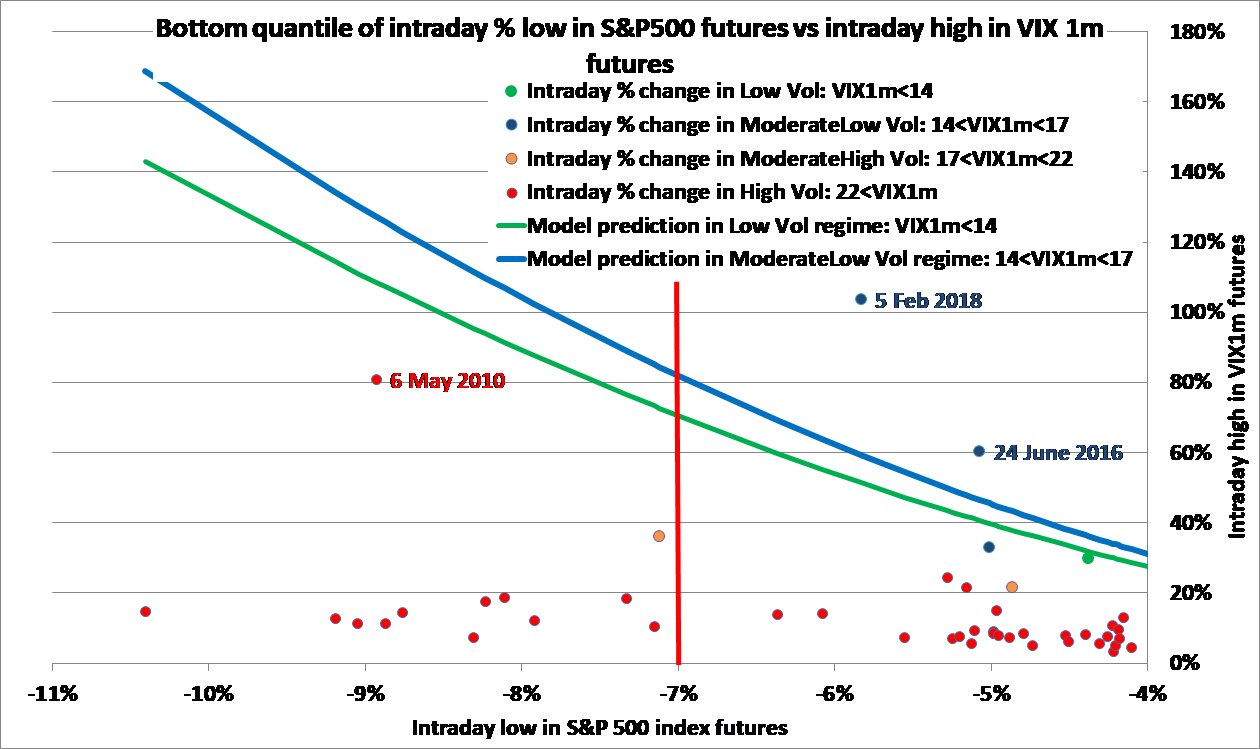
      Exchange traded products with the short exposure to the implied volatility of the S&P 500 index have been proliferating prior to “Volatility Black Monday” on the 5th of February 2018. To investigate the crash of short volatility products, I will analyse the intraday risk of these products to steep intraday declines in the S&P 500 index. As a result, I will demonstrate that these products have been poorly designed from the beginning having too strong sensitivity to a margin call on a short notice. In fact, I estimate that the empirical probability of such a margin call has been high. To understand the performance of product with the short exposure to the VIX, I will make an interesting connection between the short volatility strategy and leveraged strategies in the S&P 500 index and investment grade bonds. Finally, I will discuss some ways to reduce the drawdown risk of short volatility products.

      Key takeaways

      • Exchange traded products (ETPs) for investing in volatility may not be appropriate for retail investors because, to deliver the lasting performance in the long-term, these products need risk controls and dynamic rebalancing to avoid steep drawdowns and to optimise the carry costs from the VIX futures curve.
      • The convexity of VIX changes and the sensitivity of changes in the VIX futures to changes in the S&P 500 index is extremely high in regimes with low and moderate levels of the implied volatility. As a result, a margin call on short volatility ETPs is more likely to occur in periods with low to medium volatility rather than in periods with high volatility.
      • Without proper risk-control on the notional exposure, ETPs with the short VIX exposure are too sensitive to the intraday margin calls on a very short notice. Empirically, in the regimes with medium volatility, an intraday decline of 7% in the S&P 500 index is expected lead to 80-100% spike in the VIX futures and, as a result, to margin calls for short volatility ETPs.
      • Short volatility ETNs provide with a leveraged beta exposure to the performance of the S&P 500 index, there is no alpha in these strategies. This leveraged exposure can be replicated using either S&P 500 index with leverage of 4.2 to 1 or with investment grade bonds with leverage of 9.6 to 1. All these strategies perform similarly well in a bull market accompanied by a small realized volatility and significant roll yields, yet these leveraged strategies are subject to a margin call on daily basis.

      Continue reading →

      Share this:

      • Share on LinkedIn (Opens in new window) LinkedIn
      • Share on X (Opens in new window) X
      • Share on WhatsApp (Opens in new window) WhatsApp
      • Email a link to a friend (Opens in new window) Email
      • Print (Opens in new window) Print
      Posted in Quantitative Strategies, Uncategorized, Volatility Modeling, Volatility Trading | 7 Comments
    • Receive notifications of new posts by email

      Join 344 other subscribers
    • Recent Posts

      • The Science and Practice of Trend-following Systems: paper and presentation
      • Lognormal Stochastic Volatility – Youtube Seminar and Slides
      • Optimal allocation to cryptocurrencies in diversified portfolios – update on research paper
      • Unified Approach for Hedging Impermanent Loss of Liquidity Provision – Research paper
      • Log-normal stochastic volatility with quadratic drift – open access publication
      • Stochastic Volatility for Factor Heath-Jarrow-Morton Framework – research paper
      • AD Derivatives podcast on volatility modeling and DeFi
      • What is a robust stochastic volatility model – research paper
      • Robust Log-normal Stochastic Volatility for Interest Rate Dynamics – research paper
      • Optimal Allocation to Cryptocurrencies in Diversified Portfolios – research paper
      • Log-normal Stochastic Volatility Model for Assets with Positive Return-Volatility Correlation – research paper
      • Developing systematic smart beta strategies for crypto assets – QuantMinds Presentation
      • Toward an efficient hybrid method for pricing barrier options on assets with stochastic volatility – research paper
      • Paper on Automated Market Making for DeFi: arbitrage-fee exchange between on-chain and traditional markets
      • Tail risk of systematic investment strategies and risk-premia alpha
      • Trend-Following CTAs vs Alternative Risk-Premia (ARP) products: crisis beta vs risk-premia alpha
      • My talk on Machine Learning in Finance: why Alternative Risk Premia (ARP) products failed
      • Why Python for quantitative trading?
      • Machine Learning for Volatility Trading
      • Trend-following strategies for tail-risk hedging and alpha generation
    • Categories

      • Asset Allocation (10)
      • Crypto (8)
      • Decentralized Finance (5)
      • Python (4)
      • Quantitative Strategies (17)
      • Trend-following (4)
      • Uncategorized (20)
      • Volatility Modeling (18)
      • Volatility Trading (13)


Loading Comments...